
Profet AI Debuts Five AI Applications to Scale Expertise Amid Semiconductor Expansion
Twin Accelerator introduces five Domain Twin applications and 30-Hour Apprenticeship 2.0; Kinsus demonstrates NPI Twin
Press Release Disclaimer: This is a press release distributed through the XPR Media network. It has not been independently verified by our newsroom.
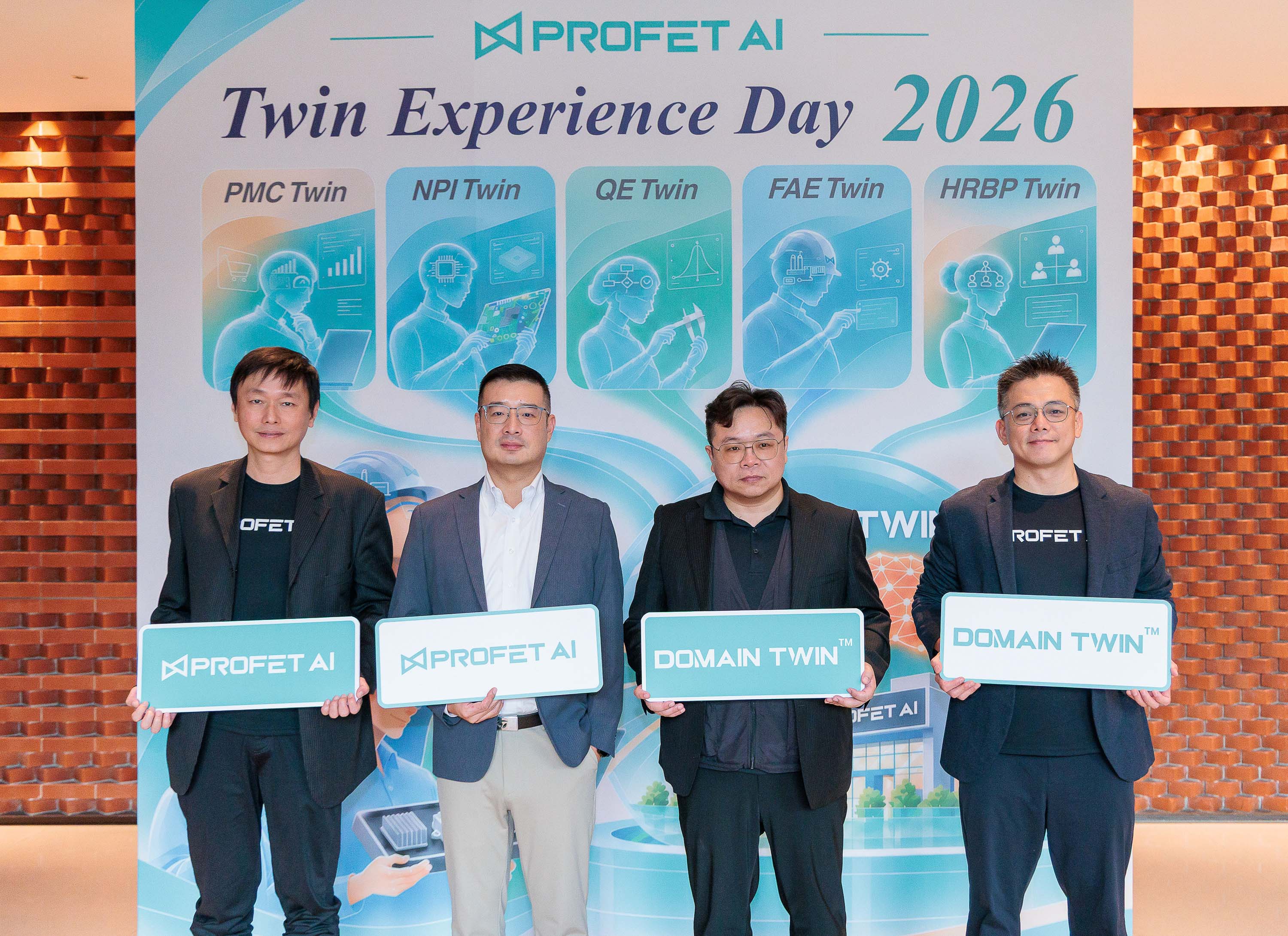

Twin Accelerator introduces five Domain Twin applications and 30-Hour Apprenticeship 2.0; Kinsus demonstrates NPI Twin in IC substrate manufacturing.
Copy quote”
TAIPEI, TAIWAN, November 18, 2026 /EINPresswire.com/ — Profet AI, a Taiwan-headquartered manufacturing AI software company, introduced Twin Accelerator with five initial applications to extend engineering expertise across production lines and plants as semiconductor capacity expands. Built on its Domain Twin™ enterprise AI platform, the initiative addresses new product introduction, equipment service, production, quality and workforce planning. The rollout is paired with 30-Hour Apprenticeship 2.0, an approach to turning experienced engineers’ knowledge into reusable AI capabilities.
A Profet AI survey of more than 400 existing manufacturing customers in Asia found plans to add more than 118 production sites/lines over the next three years, approximately 88% of them semiconductor-related.
Similar pressures accompany U.S. investment in chip fabrication, advanced packaging and testing. The Semiconductor Industry Association reports more than 160 announced semiconductor ecosystem projects across 30 states since 2020, representing more than $828 billion in planned private investment. September 2026 research from Georgetown University’s Center for Security and Emerging Technology highlights the specialized skills needed to operate new chip facilities.
“Manufacturers know they must plan for market cycles even as they expand capacity,” said Jerry Huang, co-founder and CEO of Profet AI. “The challenge is not just finding more talent, but making the experience of existing experts available to more teams. Domain Twin™ helps bring that knowledge into daily work and decision-making so companies can pursue growth while retaining operational flexibility.”
Under 30-Hour Apprenticeship 2.0, experienced engineers guide task-specific AI agents using past engineering cases, troubleshooting methods and technical judgment. The model aims to develop six to eight AI apprentices with approximately 30 hours of expert guidance. Once reviewed and approved, that knowledge can help other teams assess recurring problems and determine next steps. Higher-risk decisions remain subject to human review, and new lessons can be captured for reuse.
Kinsus Interconnect Technology Corp., a Taiwan-based integrated circuit substrate manufacturer, is an NPI Twin use case. Its broader new product introduction transformation brings together engineering records, predictive analysis and expert knowledge to help teams apply lessons from earlier programs and coordinate decisions across engineering, quality and production. Harvard Business Review Taiwan reported that the broader effort improved cross-functional collaboration efficiency by 40% and shortened new-employee ramp-up time by 35%. Kinsus’ NPI-Nexus initiative also received a 2026 Digital Transformation Dingge Award.
Kinsus is also expanding its role in the AI infrastructure supply chain. On Nov. 17, NVIDIA announced an agreement under which Kinsus plans to increase advanced ABF substrate manufacturing capacity dedicated to NVIDIA by more than 3.5 times. Kinsus announced more than $1 billion in NVIDIA investment to support the expansion, with production expected to begin in the second half of 2027.
Kinsus’ experience illustrates one application. Twin Accelerator’s initial lineup covers five manufacturing and workforce functions:
NPI Twin (new product introduction) connects product specifications, pilot-run data and prior engineering decisions to assess yield risks and process adjustments.
FAE Twin (field application engineering) draws on equipment service histories and troubleshooting knowledge to support initial fault diagnosis and technical responses.
PMC Twin (production and material control) links demand forecasts, inventory and supplier lead times to flag shortages and support procurement decisions.
QE Twin (quality engineering) connects quality records, investigation histories and test data to identify similar issues and guide follow-up inspections.
HRBP Twin (strategic workforce planning) combines employee competencies, organizational requirements and AI-agent capabilities to identify skills gaps and recommend human-and-AI team configurations.
“Creating a single AI agent is no longer the biggest challenge for an enterprise,” said James Yang, special assistant to the CEO at Profet AI. “The harder task is enabling many agents to operate securely under a common governance framework, improve over time and scale across teams and plants.”
Domain Twin™ combines AutoML, no-code machine learning for structured manufacturing data, with AI Studio, an environment for building AI assistants, digital employees and workflow-connected applications. Access controls, approvals, audit trails and on-premises deployment options help manufacturers govern proprietary knowledge across sites.
Founded in 2018 and headquartered in Taiwan, Profet AI develops manufacturing AI software that turns frontline know-how into governable, reusable AI assets. It serves more than 400 manufacturers across Asia and has worked on more than 5,500 AI application projects. Learn more at profetai.com.
Amilia Chen
Profet AI
amilia@profetai.com
Legal Disclaimer:
EIN Presswire provides this news content “as is” without warranty of any kind. We do not accept any responsibility or liability
for the accuracy, content, images, videos, licenses, completeness, legality, or reliability of the information contained in this
article. If you have any complaints or copyright issues related to this article, kindly contact the author above.

Media gallery
